
Advancing precision medicine through nano-motor inhibition
At Neuro-Horizon Pharma, our drug discovery pipeline is fueled by science and driven by purpose. We are dedicated to developing innovative therapeutic solutions by targeting fundamental biological mechanisms, specifically the F-ATP synthase and V-ATPase rotary nano-motors and small GTPases. By focusing on these essential cellular engines and signal transducers, we aim to deliver transformative therapies that address critical unmet medical needs and improve patient outcomes.
Pulmonary tuberculosis (TB) infectious disease and its spinal and meningitis neurologic complications
Scientific background and targets
| Goal | To develop specific small-molecule drugs for the treatment of pulmonary TB and its neurologic complications |
|---|---|
| Cellular Pathway | Synthesis of ATP |
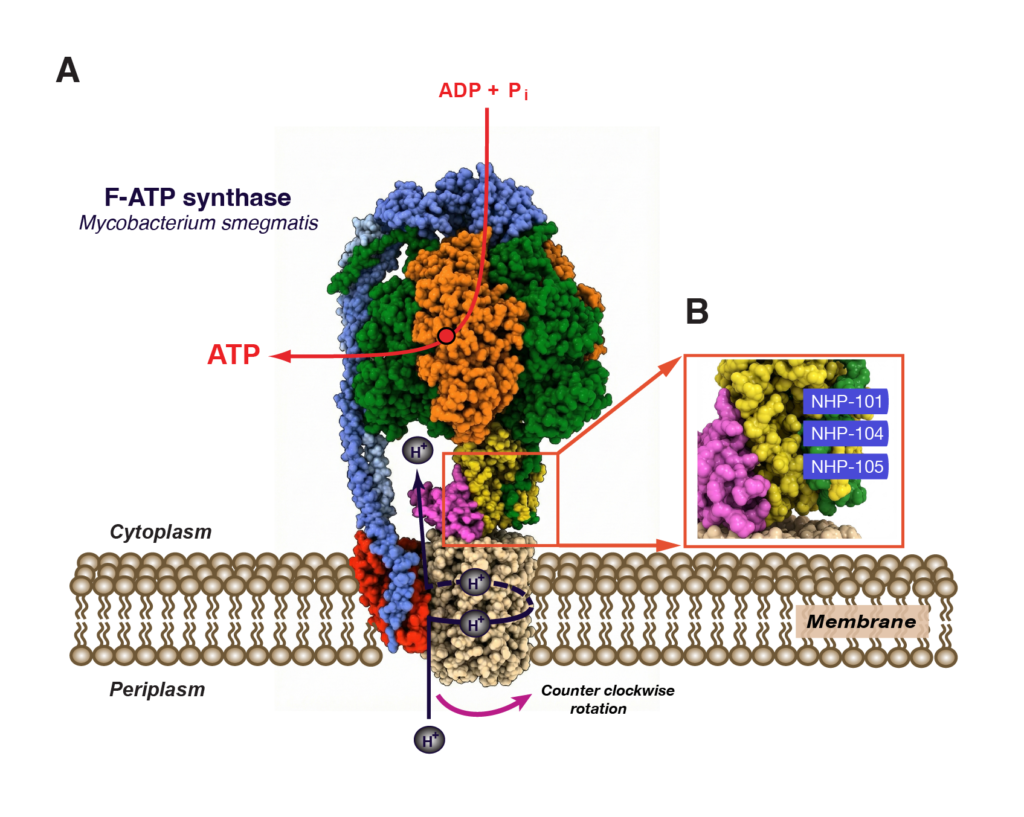
| Cellular Target | F-ATP synthase rotary nano-motor of Mycobacterium tuberculosis (Mtb) |
F-ATP synthase of Mycobacterium smegmatis (A) and specific targeting of its 𝜸-subunit with NHP-101, NHP-104 and NHP-105 small-molecule compounds (B)
Pipeline Infectious Diseases
Multidrug-resistant mycobacterial pulmonary tuberculosis (TB) and its spinal, meningitis neurologic complications.
Development of small molecule inhibitors targeting Mycobacteria tuberculosis (Mtb) F-ATP synthase for treatment of pulmonary tuberculosis (TB) infections, including:
- multidrug-resistant (MDR);
- extensively drug-resistant (XDR);
- bedaquiline-resistant (BDQR) pulmonary tuberculosis and TB spinal and meningitis neurologic complications.
DRUG
Non-tuberculosis mycobacterial pulmonary disease (NTM-PD)
Scientific background and targets
| Goal | To develop specific small-molecule drugs for the treatment of infectious NTM-PD |
|---|---|
| Cellular Pathway | Synthesis of ATP |
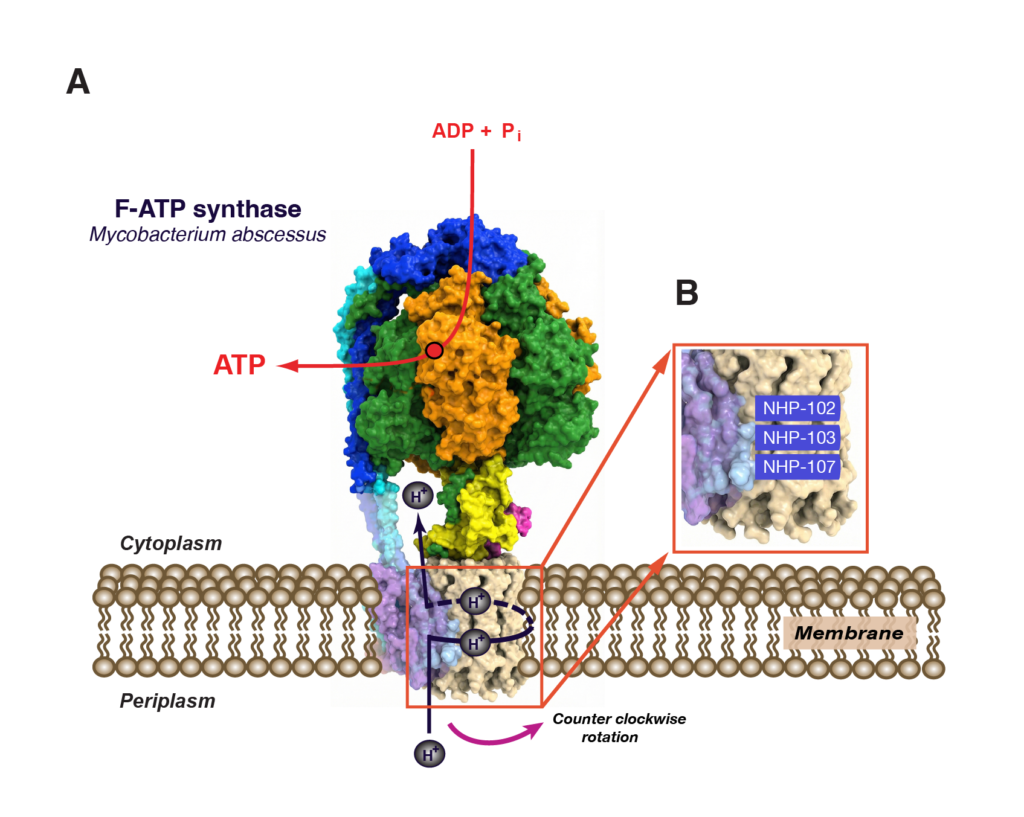
| Cellular Target | F-ATP synthase rotary nano-motors of Mycobacterium abscessus complex (Mab) and Mycobacterium avium complex (Mac) |
F-ATP synthase of Mycobacterium abscessus (A) and specific targeting of its c-ring with NHP-102,
NHP-103 and NHP-107 small-molecule compounds (B)
Pipeline non-tuberculous mycobacterial pulmonary disease (NTM-PD)
Development of small molecule inhibitors targeting F-ATP synthase of non-tuberculous mycobacteria (NTM) for treatment of NTM-PD caused by:
- rapid growers Mycobacterium abscessus complex (Mab)
- slow growers Mycobacterium avium complex (Mac)
DRUG
Age-related neurodegenerative diseases
Scientific background and targets
| Goal | To develop novel peptides and small-molecule drugs for the treatment of neurodegenerative diseases |
|---|---|
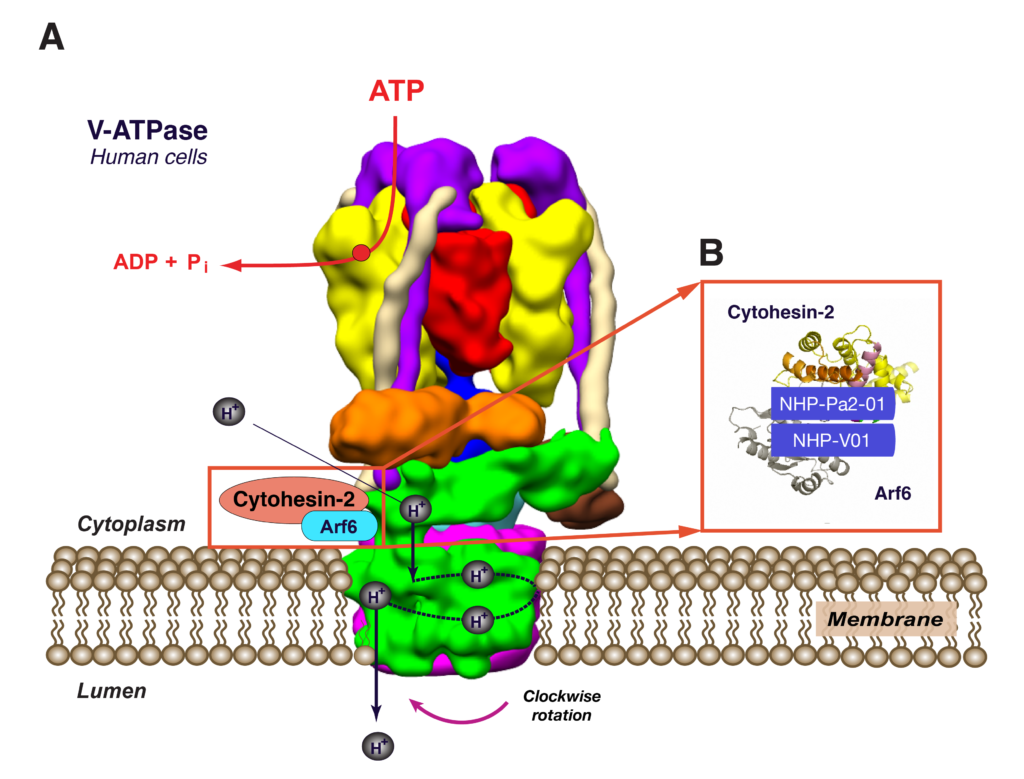
| Cellular Pathway | Signaling by cytohesin-2/Arf6 small GTPases and V-ATPase, which functions as a pH-sensing receptor |
| Cellular Target | Human cytohesin-2 /Arf6 small GTPases and V-ATPase rotary nano-motor |
The V-ATPase nano-motor functions as a pH-sensing receptor that signals through cytohesin-2/Arf6 small GTPases (A), enabling targeting of this pathway with V-ATPase-derived peptides and small-molecule drugs (B)
Pipeline Neurodegenerative Diseases
Age-related ALS and AMD neurodegenerative diseases: Development of novel peptides
Development of novel peptides targeting human cytohesin-2/Arf6 small GTPase and V-ATPase nano-motor for treatment of age-related neurodegenerative diseases:
- Amyotrophic Lateral Sclerosis (ALS)
- Age-related Macular Degeneration (AMD)
PEPTIDE
Age-related ALS and AMD neurodegenerative diseases: Delevopment of novel small molecules
Development of novel small molecules targeting human cytohesin-2/Arf6 small GTPase and V-ATPase nano-motor for treatment of age-related neurodegenerative diseases:
- Amyotrophic Lateral Sclerosis (ALS)
- Age-related Macular Degeneration (AMD)
DRUG
Every candidate in the NHP pipeline progresses through a comprehensive, data-driven lifecycle to ensure the highest standards of efficacy and safety.

 Discovery
Utilizing Drug Virtual Screening (DVS), High-Throughput Screening (HTS), and Structure-Activity Relationship (SAR) studies to identify high-potential leads.
- Validation
Establishing in vitro Proof of Concept (POC) to confirm molecular mechanism and activity.
- Optimization
Refining candidates through Hit-to-Lead Optimization and rigorous PK/PD/ADME evaluation.
- Preclinical and Clinical
Executing in vivo animal models and other IND-enabling studies for clinical entry.


